
Powder Coating for Durable Industrial Surfaces
Powder coating makes metal components durable, visually appealing, and ready for long-term use. EMAG Production offers industrial surface finishing for customers who expect more than just a coating: a reliable combination of blasting, manual powder coating, industrial painting, and quality inspection.
At the Zerbst location, complex sheet metal assemblies, machine enclosures, work area panels, machine housings, welded subassemblies, electrical cabinets, and automation components are manufactured and surface-finished. Sheet metal fabrication includes, among other things, laser cutting, edge folding, welding, surface coating, blasting, and powder coating.
Powder coating for metal components with industrial requirements on the basis of the Epoxy resin system
Powder coating is a process for high-quality surface finishing of electrically conductive materials such as steel, aluminium, or galvanized steel. The powder is applied electrostatically and then cured. This results in a uniform, durable, and visually clean surface. Powder coatings are considered long-lasting, corrosion-resistant, and solvent-free.
For industrial applications, process reliability is of paramount importance. Coated components must not only look good but also reliably withstand assembly processes, transport, cleaning, mechanical stress, and subsequent use in mechanical and plant engineering.
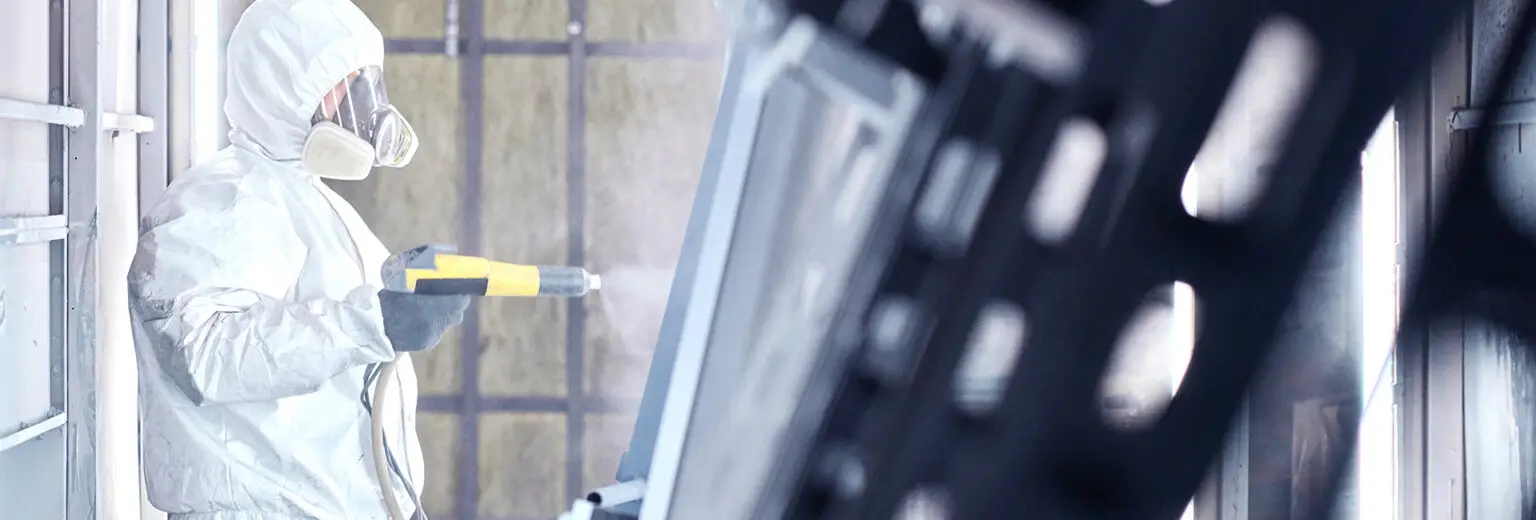
Surface finishing from a single source
EMAG Production combines sheet metal processing and surface finishing in a single, integrated manufacturing process. This reduces interfaces, simplifies coordination, and ensures that the coating, component geometry, and subsequent function are considered together at an early stage.
Benefits for your component
Manual powder coating
Flexible coating of complex geometries, edges, welded assemblies, and individual parts
Sandblasting with corundum
Intensive pretreatment, rust removal, surface roughening, and cleaning of metallic surfaces
Industrial coating
Technically clean surfaces for industrial requirements
Glass bead blasting
Gentler surface treatment for uniform, visually refined surfaces
Coating thickness measurement
Coating quality control and documentable results
Quality inspection
Measurement and inspection processes to ensure reproducible results
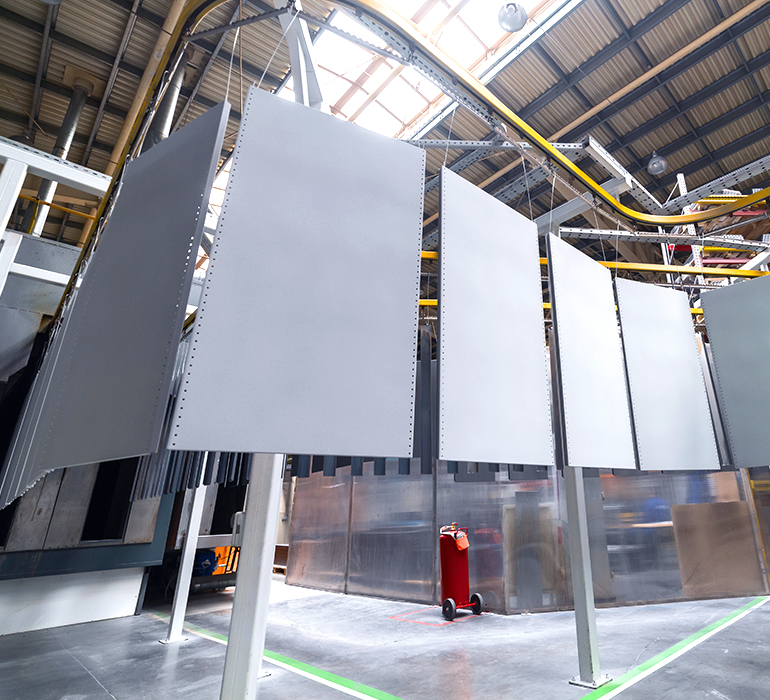
Powder coating for complex geometries
Not every industrial component is a simple, standard part. Welded assemblies, trim parts, machine components, and large-format sheet metal structures, in particular, feature edges, internal areas, holes, folds, or hard-to-reach areas. This is where powder coating offers clear advantages.
Experienced specialists can tailor the powder application specifically to the component’s geometry. Critical areas are deliberately addressed to ensure that the surface is uniform, fully covered, and functional. This is particularly important for components that will later be installed in visible locations or that also serve a protective function.
Blasting as the foundation for good adhesion
High-quality powder coating begins even before the coating process. The surface must be clean, sound, and properly prepared. Blasting removes contaminants, oxide layers, scale, or old coating residues and, depending on the process, creates a defined surface structure.
Sandblasting with corundum (particle size 0.5–1 mm) is suitable for intensive mechanical pretreatment. It is used when surfaces need to be thoroughly cleaned, roughened, or prepared for subsequent coating. Corundum is a hard abrasive and is particularly suitable when robust pretreatment is required. Preferred for thin-sheet metal production.
Glass bead blasting (particle size 200–300 µm) is used when a finer and visually uniform surface is required. The process can smooth, compact, and visually enhance metallic surfaces without creating aggressive roughness. This makes it particularly suitable for components that combine technical function with a clean appearance.
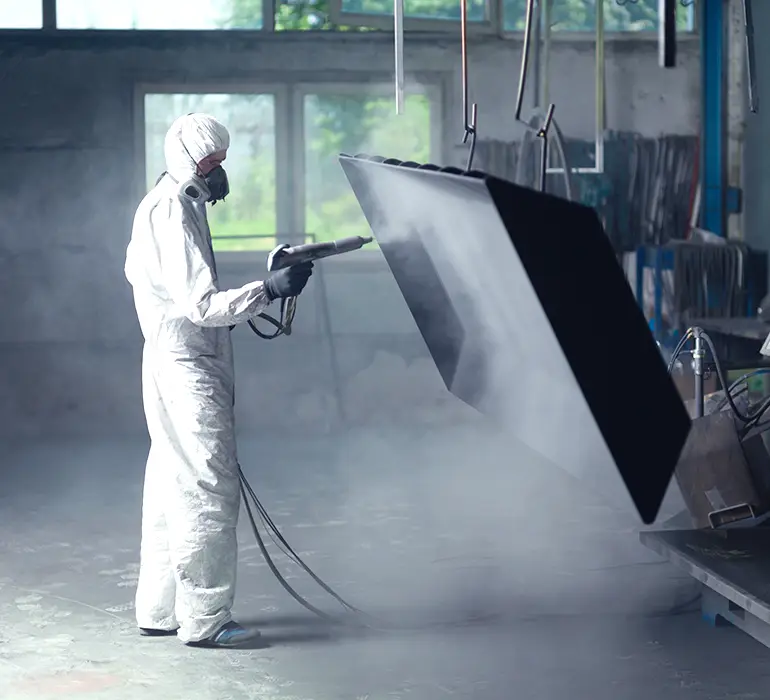
A comparison of industrial painting and powder coating
Powder coating is the preferred solution for many metal components when high durability, efficient processing, and a clean surface are required. Industrial painting remains a viable option when specific paint systems, special requirements, or certain component geometries necessitate it.
| Criterion | Powder Coating | Industrial Painting |
|---|---|---|
| Surface | Uniform, robust, decorative | Variable, also suitable for special coating systems |
| Environmental considerations | Solvent-free | Depends on the coating system |
| Applications | Steel, aluminium, galvanized components, sheet metal assemblies | Technical components with specific requirements |
| Durability | High resistance to abrasion, impact, and weathering | Depending on the coating system and pretreatment |
| Quality control | Including coating thickness measurement | Including coating thickness measurement |
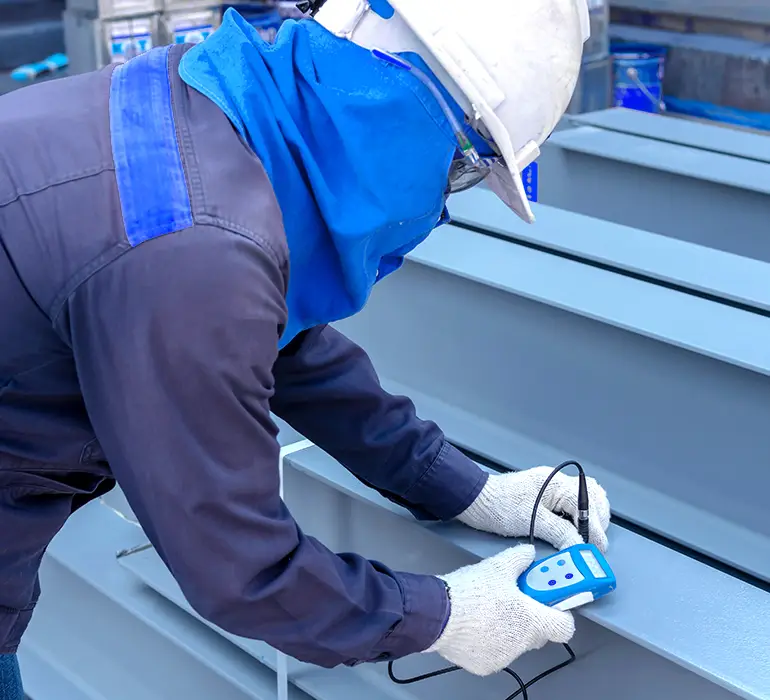
Coating thickness measurement for documented quality
Coating thickness affects appearance, protective performance, and fit accuracy. Coating thicknesses that are too thin can reduce the protective function, while coating thicknesses that are too thick can interfere with fits, threads, mounting surfaces, or defined clearance dimensions.
That is why coating thickness measurement is an important component of quality assurance. It makes coating quality measurable and supports reproducible production.
For which components is powder coating suitable?
Powder coating is particularly suitable for metal components that require long-lasting protection and a high-quality finish.
Typical applications:
- Machine enclosures and work area panels
- Electrical cabinets, control panels, and enclosures
- Welded assemblies
- Automation conveyors and machine components
- Sheet metal structures for machine and plant engineering
- Individual parts, small-batch production, and sophisticated industrial components
EMAG Production’s high level of vertical integration is a key advantage: A large proportion of the manufactured parts are produced in-house, allowing for close coordination between machining, sheet metal fabrication, assembly, and surface finishing.
Your benefits of powder coating with EMAG Production
Industrial manufacturing expertise instead of mere contract coating
Manual coating for challenging geometries
Surface finishing for complex sheet metal and welded assemblies
Quality-oriented manufacturing with documentable measurement results
Blasting, powder coating, and inspection as part of a single process chain
Suitable for external customers in mechanical engineering, plant engineering, and industry
Extensive experience with mechanical engineering components and trim parts
Looking for Reliable Powder Coating and Surface Finishing?
Contact us today to discuss your project and find the right solution for your components.